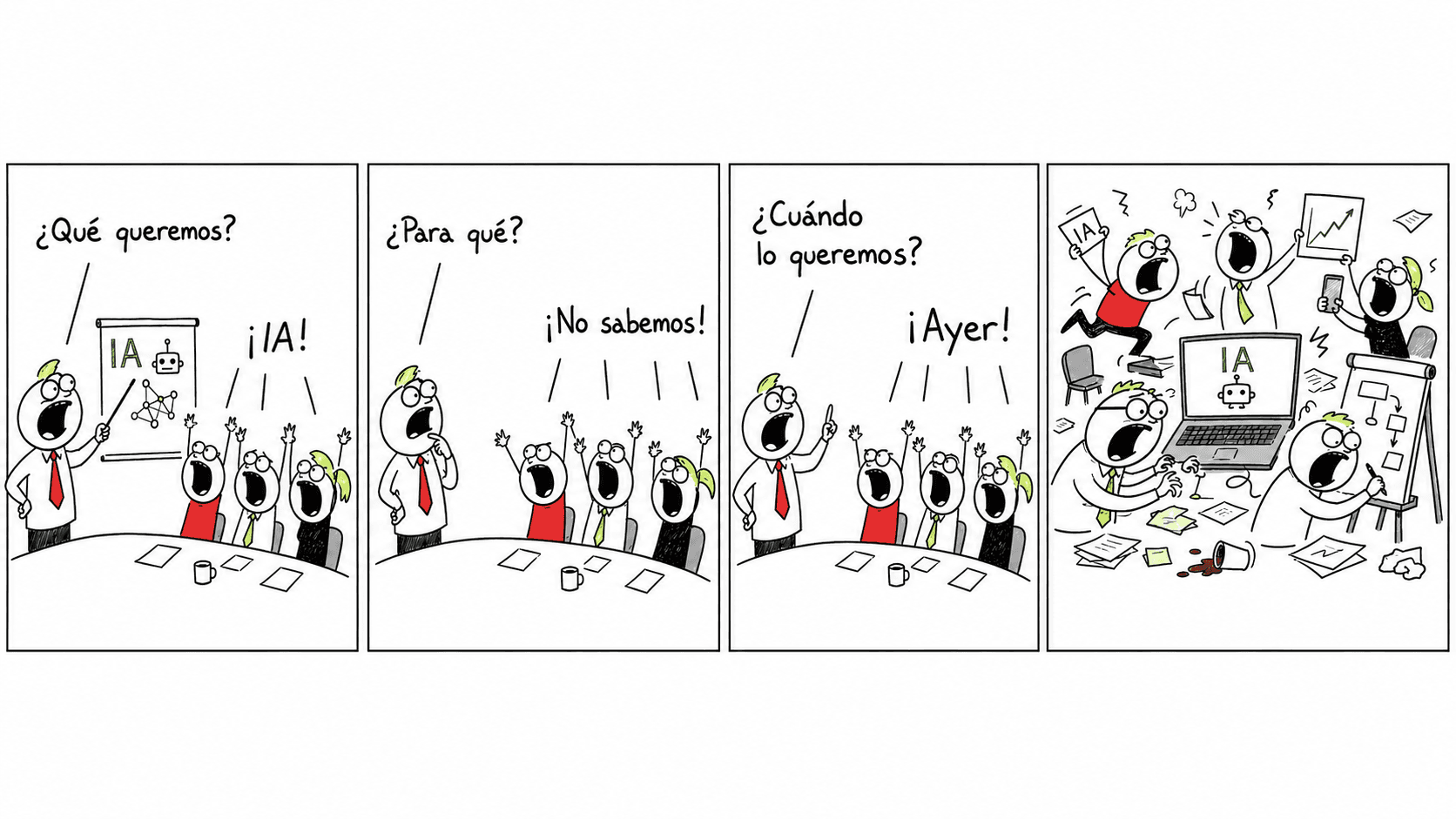

In nearly every conversation I've had with companies lately, one phrase keeps coming up — even when it's not said directly: "we need to do something with artificial intelligence." The pressure is real. It comes from the board, from senior leadership, from sales teams, from IT departments, and even from employees who are already using AI tools on their own.
The problem isn't a lack of interest. If anything, it's the opposite: too much interest, too much urgency, and very little clarity. Companies want to implement AI, but they often haven't defined what for, in which processes, with what data, at what level of risk, with what operating model, or with what internal capabilities. When that happens, AI stops being a strategic opportunity and becomes a race to "do something" before everyone else — not to mention all the self-proclaimed "gurus" selling easy answers on social media.
This isn't just a personal observation. Research from Gartner, McKinsey, IBM, and BCG all points to the same tension: AI adoption is moving fast, but the ability to turn it into real value is far from mature in most organizations. Gartner has highlighted that data availability and quality remain among the biggest challenges for sustainable AI implementation. McKinsey has noted that many companies are still stuck in a cycle of pilots and experimentation, while capturing value at scale requires working across strategy, talent, operating models, technology, data, and adoption.
What I see on the ground confirms that gap. Companies evaluating AI agents before defining which processes they want to improve. Departments buying tools because a competitor uses them. Teams experimenting with assistants, automations, and generative models without clear criteria around security, governance, or impact. And leaders who sense that something important is happening, but don't have a roadmap for turning that instinct into a concrete plan.
The conversation usually starts with the tool: "we want Copilot," "we want an agent," "we want to automate with AI," "we want to use ChatGPT company-wide." But the right conversation should start with the business: What problem are we trying to solve? What process is broken today? Where is time being lost? What decisions are being made with poor information? What customer or employee experience do we want to improve? What risks are we not paying attention to?
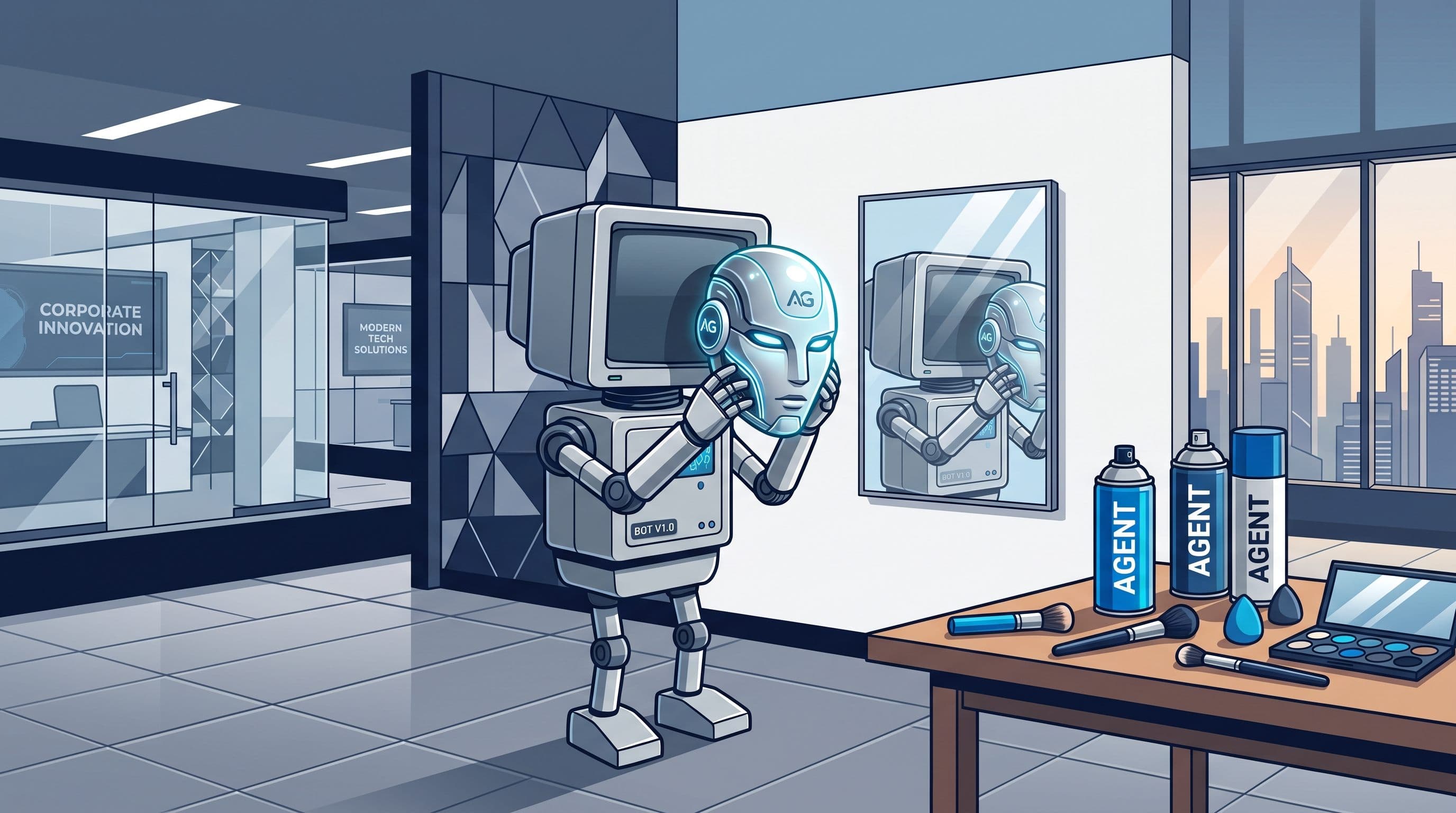
AI shouldn't be implemented as a tech trend. Nor as a defensive reaction to the fear of falling behind. Implementing AI just because "you have to have AI" can lead to frustration, unnecessary spending, disconnected solutions, and the mistaken belief that the technology doesn't work. In reality, what often fails isn't AI itself — it's the way organizations try to bring it in.
BCG has been clear on this: AI adoption doesn't happen on its own. It requires a transformation in the way the organization works, with clear leadership and a narrative that isn't "AI for AI's sake," but rather the creation of real impact. That perspective matters, because AI isn't just a technology project — it touches processes, people, data, culture, governance, and decision-making.
Another common mistake is assuming everything starts with buying licenses. Licenses may be necessary, but they're not the strategy. A company can have access to the best tools and still capture zero value if its data is a mess, its teams don't know how to use them, there are no prioritized use cases, or there's no clarity on security and compliance boundaries. IBM has also identified recurring barriers in AI adoption — concerns about accuracy, bias, insufficient proprietary data, and a shortage of internal expertise.
That's why I believe the first step isn't implementation. The first step is diagnosis.
Before talking about agents, automations, or models, a company needs to understand where it actually stands. It needs to know how prepared it is across strategy, data, technology, governance, culture, talent, and use cases. It needs to distinguish between initiatives that can move quickly and those that require more foundational work. It needs to identify which areas have the greatest potential — but also what risks could surface if it accelerates without structure.
That diagnosis doesn't have to be endless or bureaucratic. But it does have to be serious. AI moves fast, and that's precisely why companies need clarity before they speed up. Without diagnosis, speed becomes scatter. With diagnosis, speed becomes focus.
Then comes adoption. And this stage is almost always underestimated. Many organizations think adopting AI means running a tools training session. But real adoption means changing work habits, redesigning workflows, establishing usage guidelines, supporting teams through the shift, measuring progress, and building trust. It's not enough to show what a tool can do — you have to help people understand how to integrate it into their daily work in a way that's useful, safe, and consistent.
Adoption is also where initial enthusiasm separates from real value. It's relatively easy to put together an impressive demo. What's hard is having that capability embedded in operations, used by teams, measured with clear indicators, reducing friction, and improving results. McKinsey emphasizes that capturing value from AI requires management and scaling practices — not just technology experiments.
Only after diagnosing and working through adoption does it make sense to move to implementation. That's where automations, agents, integrations, internal assistants, workflows connected to enterprise systems, solutions built on proprietary data, and more advanced use cases come in. But they arrive with a clear purpose — not as a collection of disconnected tools.
At fuubo, we propose exactly that path: diagnosis, adoption, and implementation. Not because it sounds neat, but because it's the most responsible way to turn urgency into results. First, understand the company's actual maturity. Then, prepare people and the operating model. Finally, implement solutions that make sense for the business and can be sustained over time.
I'm convinced this approach works because it avoids two equally dangerous extremes: staying paralyzed while waiting for everything to be perfect, or jumping into implementation without knowing what you want to achieve. AI requires action — but action with purpose. It requires speed — but not improvisation. It requires ambition — but also governance.
The opportunity is enormous. AI can help improve productivity, accelerate decisions, reduce repetitive tasks, personalize experiences, optimize processes, and open new ways of creating value. But for any of that to happen, companies need to stop only asking "which tool should we use" and start asking "what do we want to transform."
That's the conversation missing in a lot of organizations today. And it's also the conversation that can generate the most value.
Because implementing AI isn't about chasing technology. It's about understanding your business, preparing your organization, and building real capabilities to compete in a new era. Companies that manage to do it with a method will be in a very different position from those that only accumulate pilots, licenses, and expectations.
AI is no longer a future promise. The challenge now is turning it into concrete value. And for that, the starting point isn't the tool. It's clarity.
Start with a free diagnosis at https://fuubo.ai/ai-assessment/