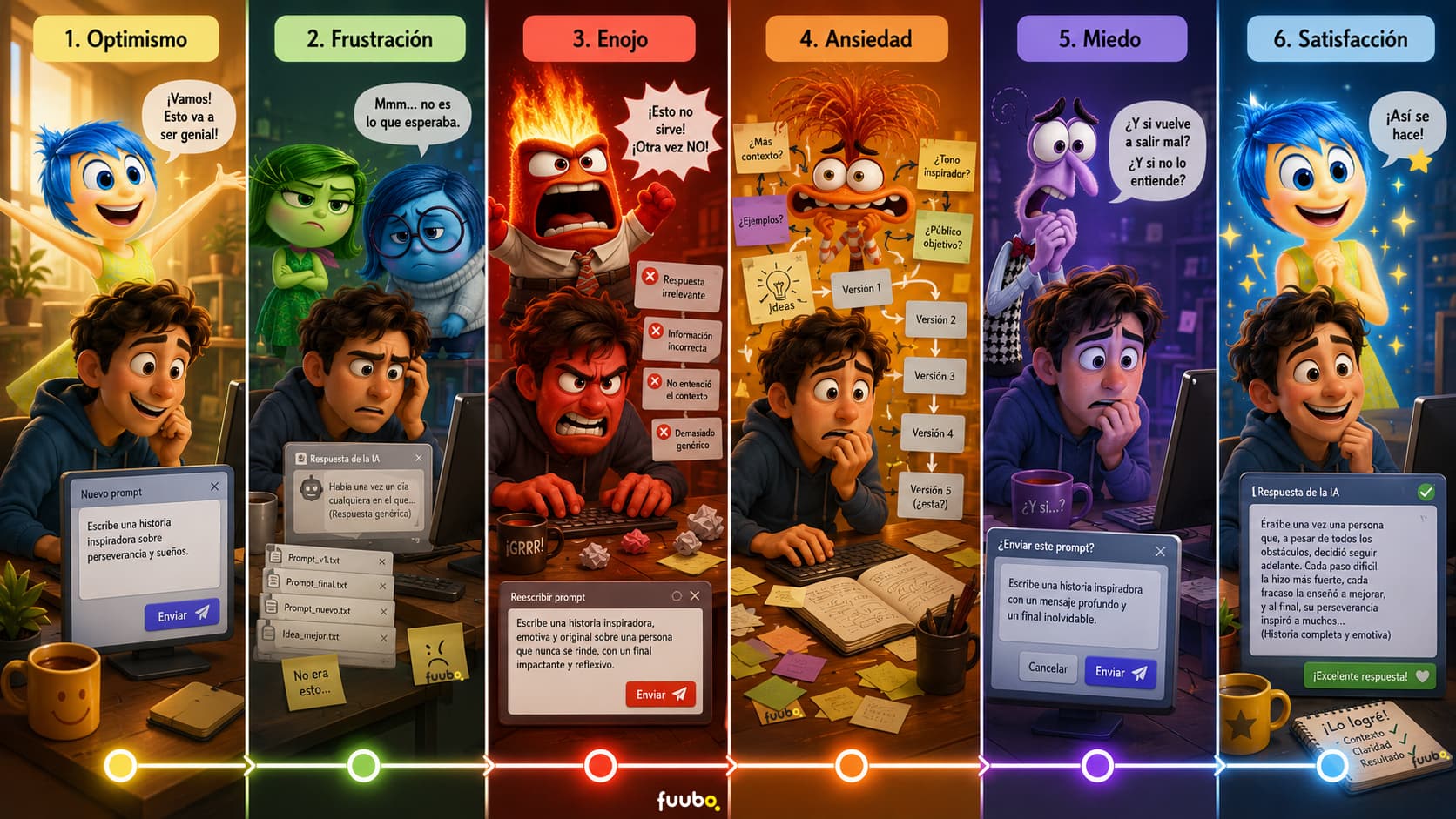

Using artificial intelligence seems simple: you open a tool, type an instruction, and wait for a useful response. But those of us who use it regularly know that the real journey isn't always that straightforward. It often starts with optimism, moves into frustration, passes through anger or anxiety, and only after several attempts — and some genuine rage — does that feeling of satisfaction finally arrive when the AI delivers something close to what you actually needed. You've probably been there, not just in a chat window, but also when building a GPT, a Gem, a Copilot Agent, or a Skill.
This experience isn't coincidental. Generative AI has enormous potential to improve productivity, but that value doesn't appear automatically. I'm not making this up — McKinsey backs it with research. It's not just about "having AI." It's about knowing how to integrate it well.
In day-to-day use, one of the main friction points is prompting. Many people start using AI the same way they'd use a traditional search engine: they type a short phrase, expect a precise answer, then get frustrated when the result is generic, incomplete, or simply unhelpful. The problem isn't always the tool. Most of the time it's that we didn't provide enough context, didn't define the goal clearly, didn't specify the expected format, or didn't explain who will be using the response. We need to ask AI for things the same way we'd ask a person — if we're vague and they don't know us, the result probably won't be what we hoped for.
That's where an interesting paradox emerges: AI promises to save time, but if you don't know how to ask it the right things, it can cost you time instead. You rewrite the prompt, correct the response, add context, adjust the tone, request another version, watch it hallucinate, and start over. What was supposed to take five minutes ends up being half an hour of trial and error.
This doesn't mean AI doesn't work. It means that interacting with it requires a new kind of skill. Microsoft has been emphasizing the importance of building practical AI and prompting capabilities within organizations — not just handing out access to tools. It even recommends ongoing training in generative AI and prompting skills as part of the new digital workplace. Once you get it working the way you want, it will work well, every single time.
Prompt engineering shouldn't be seen as something reserved for technical specialists. In practice, it's a form of structured thinking. It's learning to tell AI what role it should play, what problem it should solve, what context it needs to consider, what constraints it must respect, and what kind of result you expect. A good prompt isn't necessarily long — it's clear, specific, and outcome-oriented. OpenAI, Anthropic, Google, and Microsoft have all published solid best practices on this.
It's also important to understand that prompting improves with practice. At first, people tend to interact with AI in very open-ended ways. Over time, you start noticing patterns: which instructions work best, when it helps to give examples, when to ask for a specific structure, when to break a large task into smaller steps, and when to correct a response rather than starting from scratch. The learning curve is real, but it shortens considerably when you approach it with intention.
The opposite risk is using AI uncritically. Some studies warn that superficial use of these tools can produce content that looks correct but is thin on substance. This has been called "workslop" — AI-generated work that appears finished but actually shifts the burden of review, correction, or interpretation onto someone else. Instead of boosting productivity, it ends up creating more friction. You've probably noticed that AI tends to find every idea and plan fantastic — it has a built-in optimism. There are real cases of official documents submitted with invented data, or blog posts and social media content that bear no trace of the author's actual voice.
That's why the real value isn't in writing just any prompt — it's in learning to have better conversations with AI. The tool can help you think, synthesize, draft, compare, structure, and create. But it needs direction. When you use it without context, you get generalities. When you guide it well, it becomes a genuine accelerator.
The emotional arc of prompting mirrors this process closely. First you believe AI will solve everything instantly. Then you're disappointed when it doesn't understand you. You get annoyed when it keeps giving irrelevant answers. You grow anxious trying to craft the perfect prompt. You hesitate before hitting send again. And finally, when you nail the context, the goal, and the format, a genuinely useful response appears.
That final satisfaction doesn't come only from the AI "getting it right." It comes from the fact that you also learned to ask better.
At the end of the day, prompting isn't a technical barrier — it's a new form of workplace literacy. Companies that want to capture real value from artificial intelligence shouldn't stop at enabling tools. They need to train their teams to use them with judgment, context, and practice. Adoption. Because productivity with AI doesn't come from clicking "send" — it comes from learning to frame the problem better.