

In corporate hallways and boardrooms alike, one concept keeps coming up like a mantra: AI Agents. Yet in day-to-day operations, a mistake as common as it is costly keeps repeating itself: treating an intelligent agent as if it were a traditional automated workflow — or the other way around.
According to McKinsey's State of AI report, despite the massive adoption of Artificial Intelligence, only 39% of companies report measurable EBIT impact attributable to the technology. Why does this gap exist? The answer isn't a lack of budget or model capability. The secret to not wasting resources lies in understanding what each tool is actually for — and redesigning the right workflows around that understanding.
At Fuubo, we sum it up simply: efficient automation divides tasks between what is predictable and what is ambiguous.
The Traditional Workflow: The Solution for What's PREDICTABLE
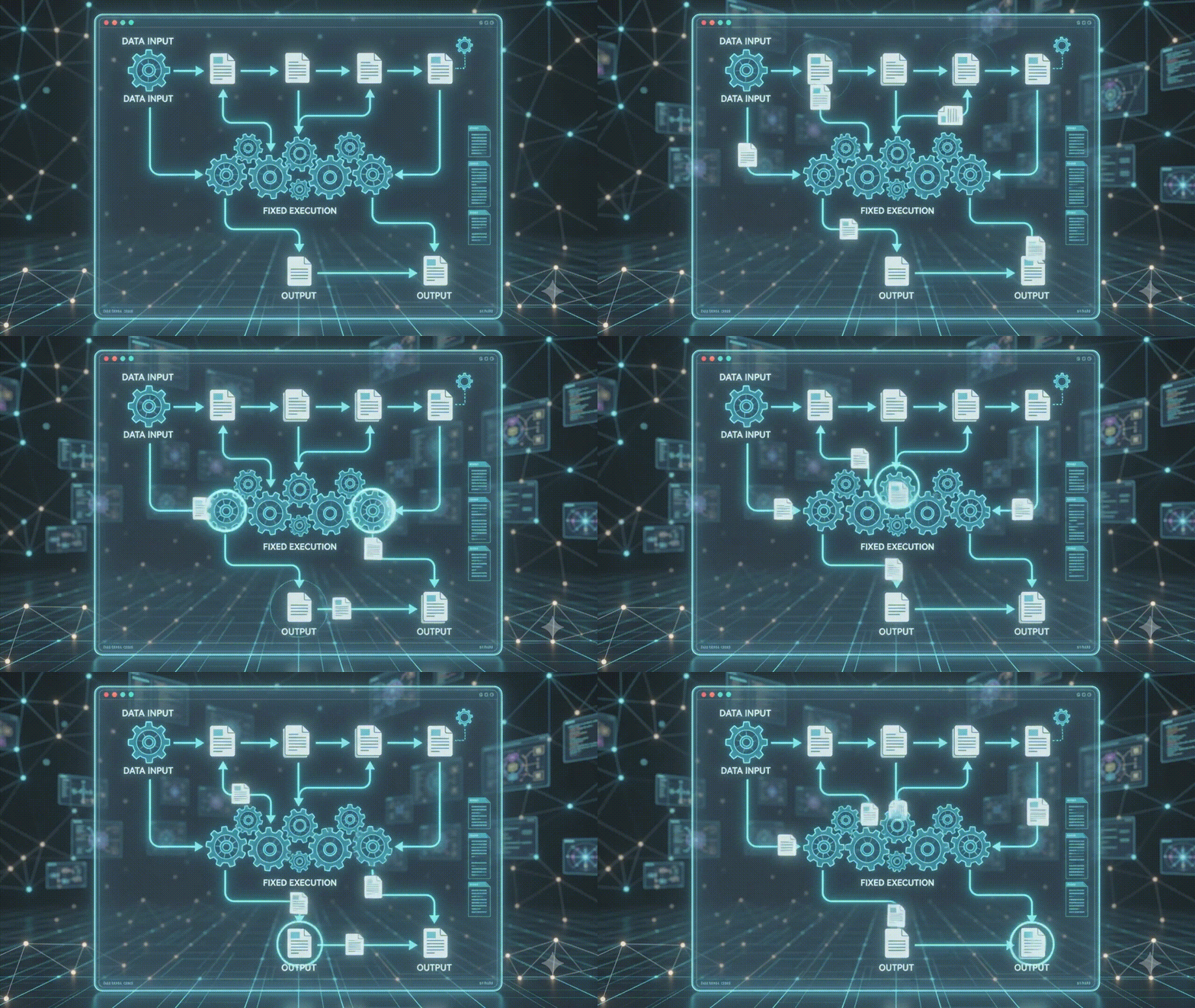
An automated workflow follows a strict recipe. Its structure operates on "If A happens, then do B" logic. It doesn't interpret, it doesn't process nuance, and it has no judgment — it simply executes instructions to perfection.
- How does it work? Through fixed rules. For example: "Every time a PDF file tagged 'Invoice' arrives, extract the numerical data and automatically upload it to the company's ERP."
- Ideal for: High-volume, repetitive, mechanical tasks where zero error tolerance is required.
Traditional workflows are the engine of back-office efficiency — but they have a clear limit: they break down immediately when human complexity or unpredictability enters the equation.
The AI Agent: The Answer for What's AMBIGUOUS

Unlike rigid software, an AI Agent doesn't operate on a predetermined path. It's given an objective, equipped with tools and context, and it makes autonomous decisions to solve the problem.
- How does it work? It leverages the reasoning capabilities of foundation models to interpret complex variables. For example: "Read this email from an upset customer, analyze their history in the database, decide whether policy entitles them to a refund or technical support, and draft an empathetic response that resolves their issue."
- Ideal for: Processes involving unstructured data, dynamic human interactions, and scenarios where context must be evaluated before taking action.
This isn't a futuristic trend. Gartner projects that by the end of this year, 40% of enterprise applications will incorporate task-specific AI agents, transforming software from passive tools into autonomous collaborators.
The Cost of Not Knowing Which to Choose: Frustration or Burned Budgets
Failing to understand this boundary shows up directly on the income statement. Forcing a rigid, outdated workflow to handle the subtleties of customer experience or complex decision-making only produces chaotic processes and frustrated users.
On the other hand, designing an expensive AI Agent — with all the compute infrastructure and token consumption it requires — to handle a linear task that could have been solved with a simple script or traditional software is, quite literally, throwing money away.
The automation that actually moves the needle for a business doesn't pick a side: it orchestrates a seamless collaboration between both worlds, letting workflows provide the control and agents provide the judgment.
Break Through the Experimentation Ceiling
Artificial Intelligence is no longer a novelty for flashy pilots — it is the foundation of the new operational infrastructure. If your team's current tools feel inadequate against market demands, or if AI in your company has become an "expensive toy" that generates no tangible returns, it's time to change the approach.
Let's move past technological inertia. Let's build a strategy grounded in diagnosis and efficiency.
Let's talk. At Fuubo, we help you design the roadmap your operation needs.