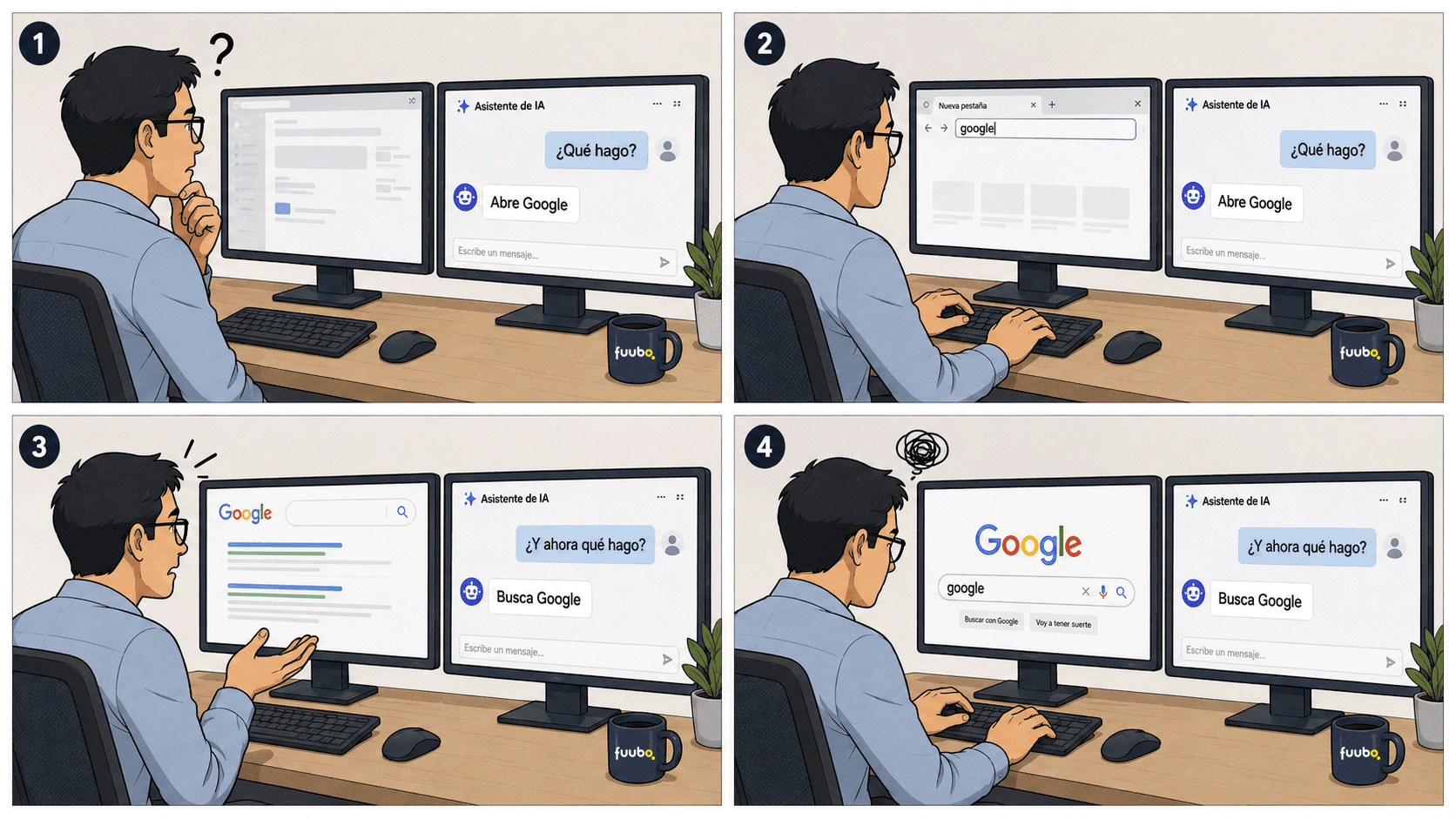

There is an image that repeats itself in almost every company that claims to be "using AI": someone opens ChatGPT in a separate tab, asks a question, copies the answer, goes back to their CRM, email, or spreadsheet, and continues working as before. The cycle repeats several times a day. The person feels they are adopting AI. The company believes it too. But in practice, what is happening looks much more like searching Google than transforming an operation.
The problem is not the tool. The problem is where it lives.
When AI exists as a window separate from the real flow of work, its impact is tied to each individual's willingness to go and consult it. It depends on someone remembering to use it, knowing what to ask, having time to copy and paste, and deciding when to incorporate the answer into what they were already doing. In that model, AI does not change the process: it is added on top of it, like one more query within a day that was already full.
The real difference appears when AI enters the flow. Not as a tab that opens at will, but as a capability that is present where work happens: in the CRM when a new opportunity is logged, in email when a query needs a response, in the help desk system when a ticket arrives, in the ERP when an invoice is processed, in WhatsApp when a customer asks a question outside of business hours. When AI is there, inside the process, it no longer depends on individual habit. It becomes part of the operation.
This is not just a technical distinction. It is an adoption distinction. A company can have access to the best tools on the market and still generate little value if each person uses them in isolation, disconnected from the processes that actually drive the business. The personal habit of using AI is not the same as organizational adoption of AI.
The leap that few companies have made yet is moving from individual use to integrated use.
What is changing in the industry right now accelerates that conversation. The major technology players are no longer selling only personal assistants: they are pushing agents that live inside business platforms. Assistants that operate in WhatsApp, in customer service systems, in approval workflows, in team productivity tools. Not for a person to consult, but to operate continuously within the process, with human oversight where appropriate.
This does not mean that individual use has no value. It does, especially for people who have already developed the judgment to get the most out of it. But at the company level, the structural value appears when AI stops being an option that someone can choose to use or not, and becomes part of the flow that defines how work gets done in that organization.
The challenge for leaders is to understand that this leap is not driven by technology alone. It requires looking at real processes and deciding which ones have enough volume, repetition, and clarity of criteria for AI to live within them. It requires defining where it makes sense to automate, where it makes sense to assist, and where we still need a person to make the decision without intermediaries. Not every process is ready. Not every team is prepared. But the question should no longer be "are we using AI?", but rather "in which part of our operation is it integrated, and what measurable result is it generating?".
The excuse that technology is missing no longer exists. What remains is deciding where to put it to work.