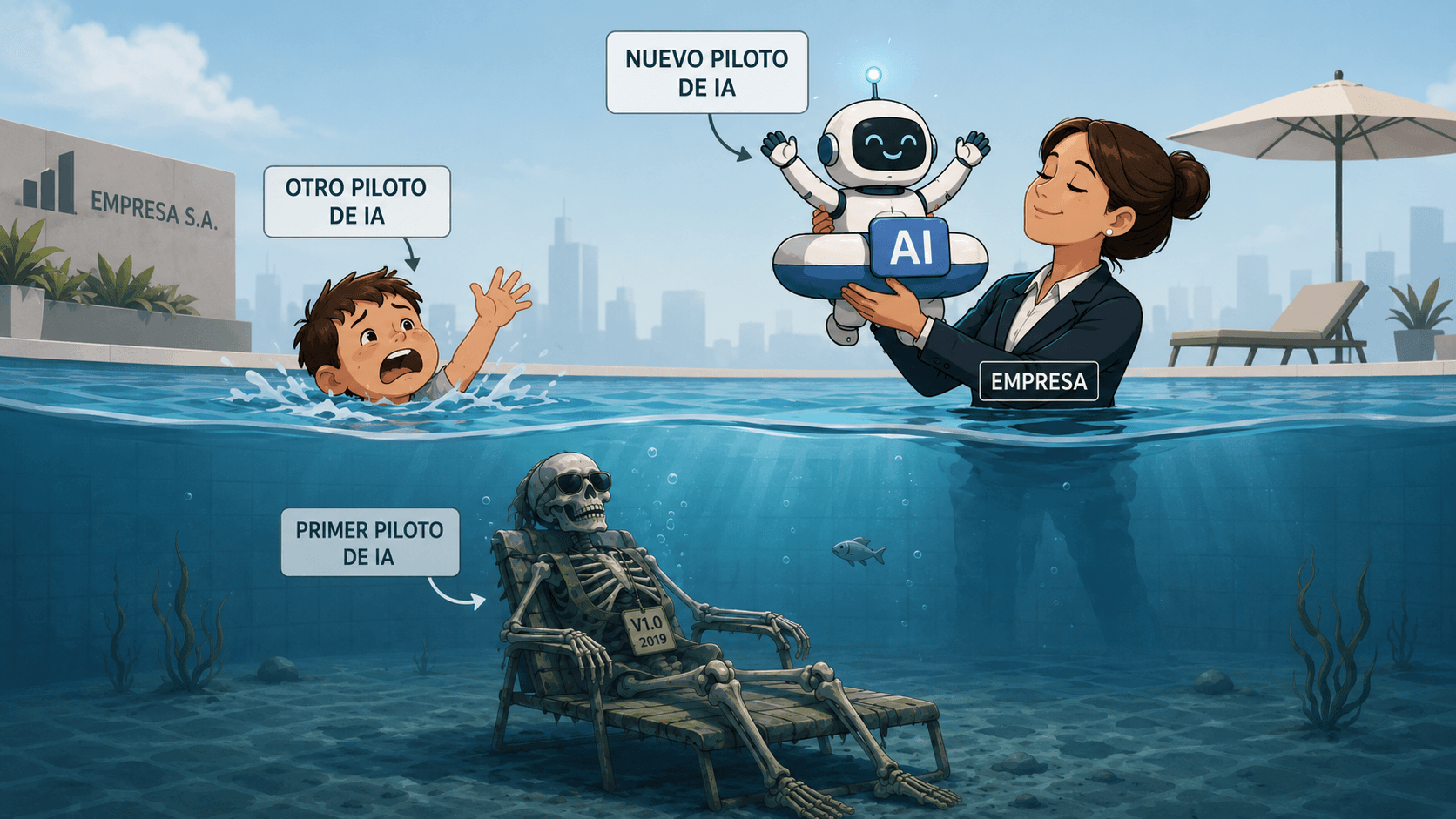

In recent months a scene keeps repeating that no longer surprises anyone working close to AI projects inside companies: a pilot launches, performs better than expected, generates real enthusiasm in the team that pushed it forward, and a few months later it simply stops being there. No one canceled it in a meeting, no email announced its closure. Someone just notices one day that nobody is using it, that the dashboard hasn't been checked in weeks, or that the process quietly went back to being done the old way.
Several recent reports on AI adoption in the corporate world describe this same pattern: a good share of the pilots that did show results end up falling apart somewhere between the third and ninth month of life. What's striking isn't that bad pilots fail, that's expected and even healthy. What's striking is that the ones that worked are the ones that fall.
The thesis is simple, and by now fairly uncomfortable: the problem isn't the model. The problem is that nobody defined, from day one, who owns that solution operationally, or what business metric would justify keeping it alive.
When an AI pilot gets built, it's almost always driven by a motivated team with solid technical judgment and a genuine desire to solve something. A tool gets chosen, tested on a narrow case, the initial result gets measured, and it gets presented with pride. All of that is fine. The problem shows up afterward, when that pilot needs to stop being an experiment and become part of the company's normal operation. That's where there's almost never clarity about who keeps it running once the initial enthusiasm fades, who's accountable if something breaks, who decides whether it's worth continuing to invest in improving it, and above all, what concrete business number that pilot was supposed to move.
Without operational ownership, any AI initiative ends up floating between departments. The team that built it has no mandate to keep it in production indefinitely, because that isn't their job. The business area that benefited from the pilot doesn't feel like it owns the tool, because it never took part in deciding on it or in defining how to measure it. And without metrics agreed on from the start, there's no way to defend the project's continuity once someone asks whether it's still worth paying for. The conversation turns subjective, based on impressions ("it seemed to help") instead of data, and in that conversation, the new tool almost always loses to the old way of doing things.
This has a direct implication for whoever leads these initiatives inside a company: the right question isn't just which use case to try, but who will be responsible for that solution six months from now, and what number will be used to judge whether it kept generating value. If those two questions don't have an answer before the pilot starts, something with an expiration date is already being built, even if the initial result is excellent.
Defining ownership doesn't mean bureaucratizing every AI experiment or demanding a committee before trying anything. It means something simpler: that someone on the business side, not just in technology, takes charge of sustaining the solution once it stops being novel. And that from the first day there's a business metric, not just a usage metric, that allows a reasoned decision about whether to continue, adjust, or shut it down.
The real risk these days isn't that companies are trying too many AI tools. It's that they keep treating every successful pilot as a finished achievement, when it's actually just the starting point of an operational decision nobody has made yet.