
There is a misconception that comes up more and more frequently in enterprise AI conversations: the idea that an AI agent is basically a more capable chatbot. Something that responds better, understands more complex questions, and has access to more information. The difference, however, is much deeper. And understanding it clearly is what separates a thoughtful adoption from one that can create real problems.
An AI agent does not just respond. It acts. It can query databases, send emails, create records, execute code, call external APIs, make chained decisions, and trigger processes in other systems. When a company puts an agent into production, it is no longer evaluating the quality of a response. It is authorizing a system to do things. That is the difference that matters.
For the past several years, the conversation around AI has focused on response quality: how accurate the model is, whether it hallucinates, whether the tone is right. Those questions are still relevant, but in the world of agents they fall short. When an agent operates in a real environment, the risk is not in what it says, but in what it executes. A misconfigured agent can modify the wrong record, complete a transaction that should not have gone through, or send sensitive information to the wrong recipient. The error is no longer just text on a screen. It has consequences in real systems.
This does not mean agents are inherently dangerous. It means they require a different design approach than a conversational tool, and a level of governance that many companies do not yet have on their radar.
When does an agent actually make sense?
Not every use case needs one. Agents work well when there is a repeatable process with clear steps, when business rules are stable enough for the system to apply them without ambiguity, when integration with the relevant systems exists, and when there is human oversight at critical points. When those conditions are met, an agent can accelerate operations, reduce manual errors, and free up people's time for higher-value work.
When those conditions are not met, the agent adds complexity without adding value. An ambiguous process that a human resolves through judgment and experience will not improve by handing it to an autonomous system. In several cases we have seen at fuubo, the right answer was not an agent: it was a simpler automation, well integrated and properly monitored. That already generates value, without the risks of full autonomy.
One of the least discussed risks is that of identities. When an agent acts on behalf of a system or a person, it needs credentials to do so. Those credentials grant access to real resources. What happens if the agent has more permissions than it needs? Who audits what it did, when, and on whose behalf? How are access rights revoked when an agent should no longer be operating? These are identity management and security questions, not AI questions in the strict sense. But with agents, they become urgent. The current trend is to adopt first and deal with governance later. That sequence is what creates problems.
The word "autonomous" does not mean the system should operate without any oversight. It means it can make decisions without requiring a human instruction at every step. A well-designed agent has breakpoints where it stops, checks in, or escalates to a person: not because it cannot continue on its own, but because some decisions carry risks the business does not want to take without review. Defining where those points are is a design decision, and one of the most important ones to make before turning any agent on.
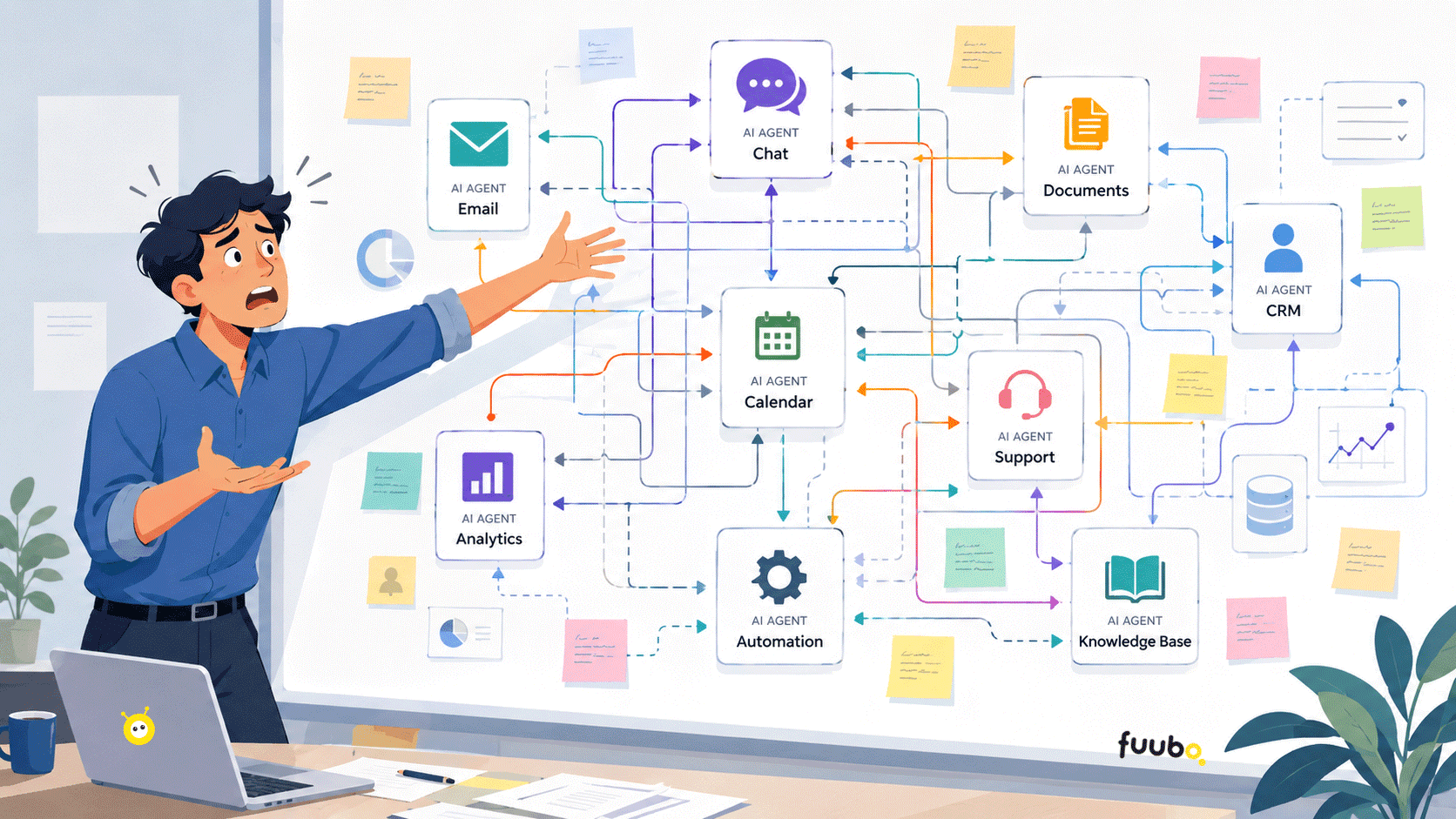
There is a scenario becoming more common in more advanced organizations: multiple agents operating in parallel, coordinating with each other, with access to different systems. The complexity is not linear. Each new agent multiplies the surface of possible failures and the difficulty of tracing which decision was made, when, and why. In that context, monitoring stops being a screen with logs and becomes an operational capability. It requires tools, processes, and people who understand what they are looking at. Many organizations that are excited about agents today do not yet have that capability in place.
AI agents are a real capability and make sense in many contexts. But the question a company should ask before adopting them is not "how do we implement them?". It is "are we ready to manage what they can do?". The difference between an agent that generates value and one that generates a problem is often just that: the preparation that happened before turning it on.