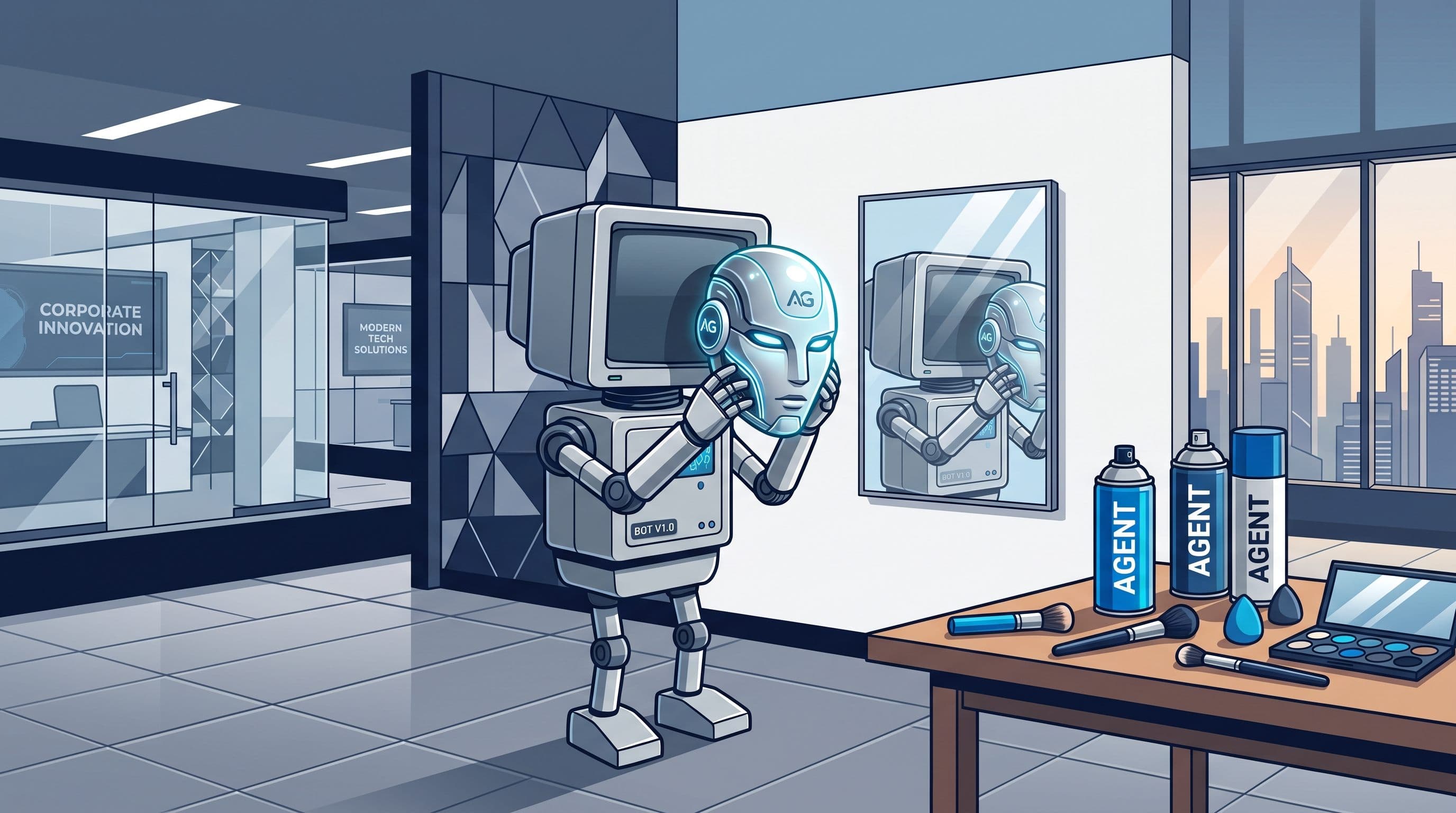

Many vendors are relabeling chatbots and automations as "autonomous agents." Before you sign off on the next AI budget, it's worth knowing how to tell one from the other.
Over the past few months you've probably received dozens of "agent" proposals, plus the occasional email with the same word in the subject line. The question worth asking is a direct one: how many of the tools you're evaluating actually are agents?
When a vendor takes a traditional chatbot, a copilot, or an RPA-style workflow, renames it "AI agent," and sells it as if it had an autonomy it was never built with, that's what Gartner has termed Agent Washing.
This isn't a minor detail or a fringe phenomenon. Industry reports show that only a small fraction of what's sold today as "agentic" meets the actual definition. The vast majority are familiar tools with a new coat of paint.
The problem isn't the misuse of the word; it's that paying agent prices for a basic tool gets expensive. And the hit shows up months later, when the project simply fails to deliver the promised results.
What separates a real agent from a repackaged chatbot?
The definition isn't complex, even though the marketing makes it seem that way.
A traditional chatbot or automation responds within a script. If the process or conversation strays from the expected path, it gets stuck or needs a person to step in and finish the task by hand. A real agent observes the situation, reasons about what to do, acts on your underlying systems, and can adjust its own plan if something doesn't go as expected.
The litmus test in practice is simple: a chatbot reads and responds; an agent reads, acts, and leaves something changed in the system (updates a record, schedules a meeting, triggers a process in another tool) without a human having to click the final button.
4 key questions before you sign
You don't need to be technical to evaluate this. It's about demanding concrete proof, not rehearsed demos:
- Ask for the unscripted test: have the agent execute a multi-step task using real, unplanned data from your operation. A true agent adapts; a disguised automation breaks.
- Ask whether it has read and write access: an agent that only "looks" at information doesn't solve anything on its own. To be worth it, it needs to be able to write to and update your systems.
- Ask for a case that spans different systems: if it can't pull data from one platform, cross-check it against another, and update a third in a single flow, it lacks the autonomy you're being sold.
- Demand the exception path: what happens when the agent can't resolve something on its own? Who finds out, how does it escalate, and where does it get logged? A serious vendor has that answer ready instantly.
These are business questions, not code questions. Any vendor that has actually built an agent will answer them without hesitation.
Why this conversation matters right now
August and the year-end months are when companies put together their technology and AI budgets. It's exactly the moment when more proposals with the word "agent" are going to land on your desk.
Buying blind has a double cost: you not only overpay for what you don't get, but if the project fails, the wrong conclusion tends to be "agents don't work." The real problem was never the technology, it's that you never bought an agent in the first place.
This doesn't mean every process needs full autonomy. Many problems are solved perfectly well with a well-designed workflow, no full agent required. It's not about distrusting everything, it's about no longer accepting the label as sufficient proof.
Before signing off on the next AI budget, the question isn't how smart the sales pitch sounds. It's what happens when you ask that tool, with real data and no script, to go out and do the work.